


Source: https://jp.corp-sansan.com/
Sansan (4443) Key Metrics
Share Price (Sep-26): ¥2,137 (as of Sep.18, 2026)
Market Cap: Approx. ¥267.2 billion
Shares Outstanding (ex-treasury): 126,137,942
Enterprise Value (EV): Approx. ¥231.6 billion
EV/EBITDA (Trailing Twelve Months, as of Sep-26): 25.1x
EV/EBITDA (FY2026 Company Guidance Basis, as of Sep-26): 15.8x
Forward PER: 28.74x (fiscal year ending May 2027) / 23.02x (fiscal year ending May 2028)
Trailing PER (High-Low Average): 360.3x / 208.6x
Trailing PBR: 13.28x
Gross Profit Margin: 87.9%
EPS (FY2025 actual, fiscal year ended May 2026): ¥53.58
EPS (FY2026 guidance, fiscal year ending May 2027): ¥66.41-¥81.04
ROE: 38.8%
Equity Ratio: 38.4%
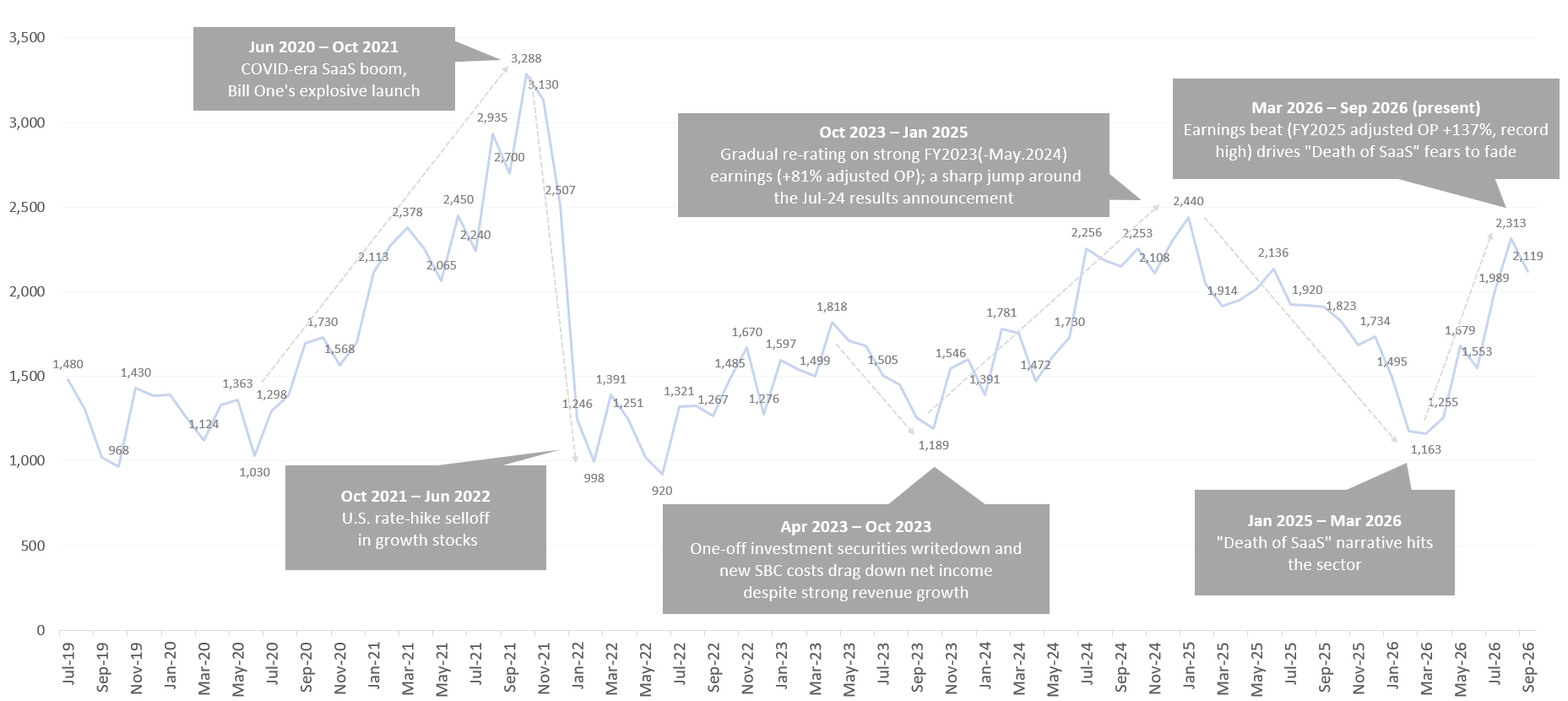
Source: Compiled by JPARCVUE (Sansan share price, Jul 2019 – Sep 2026)
INTRODUCTION
Around March 2026, Sansan’s stock, like many other domestic SaaS names, went through a tough correction.
Investors around the world had grown worried about seat based pricing, the model where SaaS companies charge based on the number of users. The concern was that AI agents could soon handle much of the work people currently do, which would shrink the number of paid seats needed.
This narrative, often called the death of SaaS, weighed on the entire sector regardless of how individual companies were actually performing.
Since then, the picture has started to shift. In its July 2026 earnings release, Sansan reported adjusted operating profit up 137 percent year over year, a record high for the company.
Its trailing PER, which had briefly reached levels in the hundreds and become essentially meaningless as a valuation tool, has come down along a different measure. Looking at EV to EBITDA, the multiple has fallen from 125.5 times to 19.2 times.
It appears the market is now paying closer attention to the company’s own results and growth prospects, rather than reacting to sector wide themes.
This piece looks at why Sansan seems to be moving from a stock priced mainly on a growth narrative to one that can be judged on actual earnings. We will walk through the business, its growth drivers, financial health, valuation, and the catalysts and risks that could shape what comes next.
To state the conclusion up front, we do not see clear evidence that the stock is cheap. Still, we think the growth story here is worth following closely.
Company Overview and Business Results
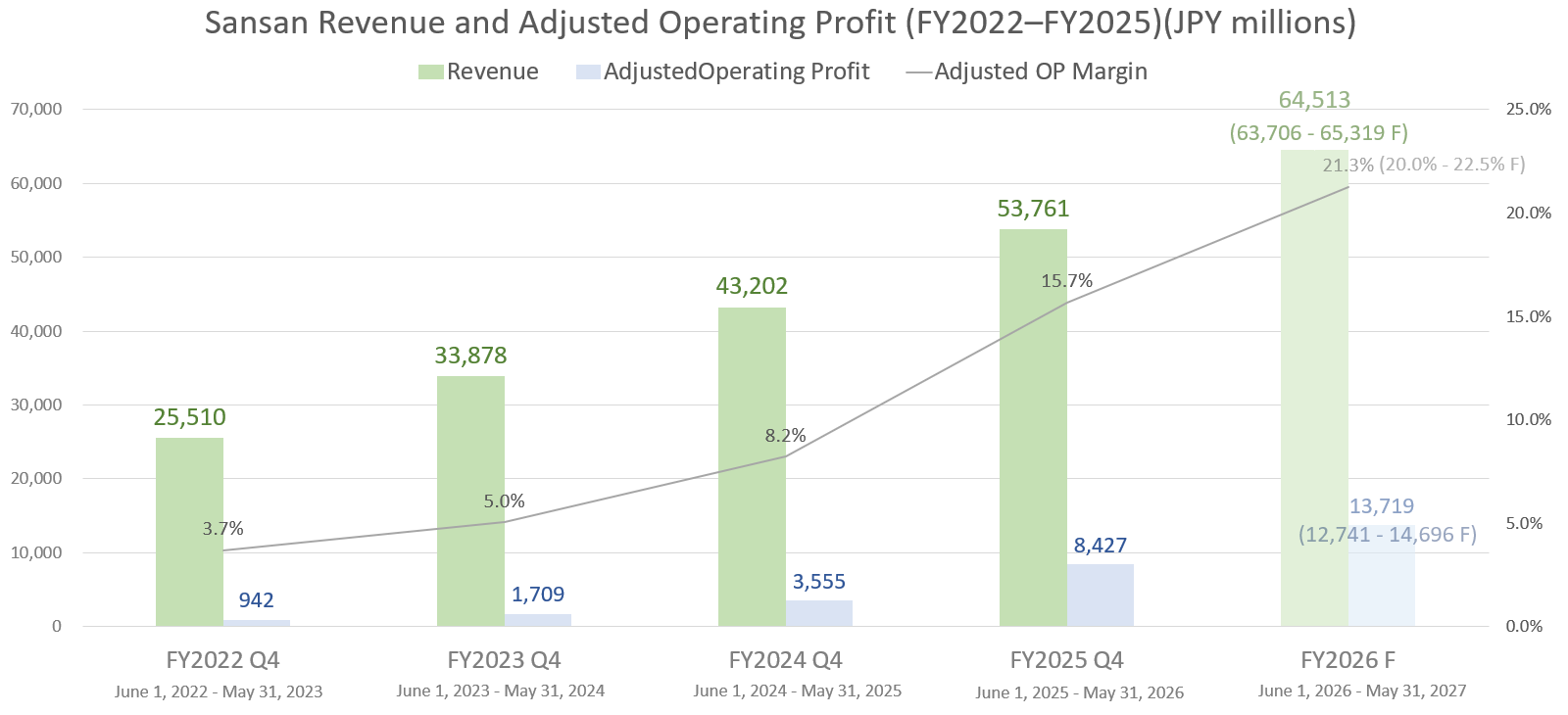
Revenue has more than doubled over four years while the adjusted operating profit margin climbed from 3.7% to 15.7%, with FY2026 guidance pointing to further improvement.
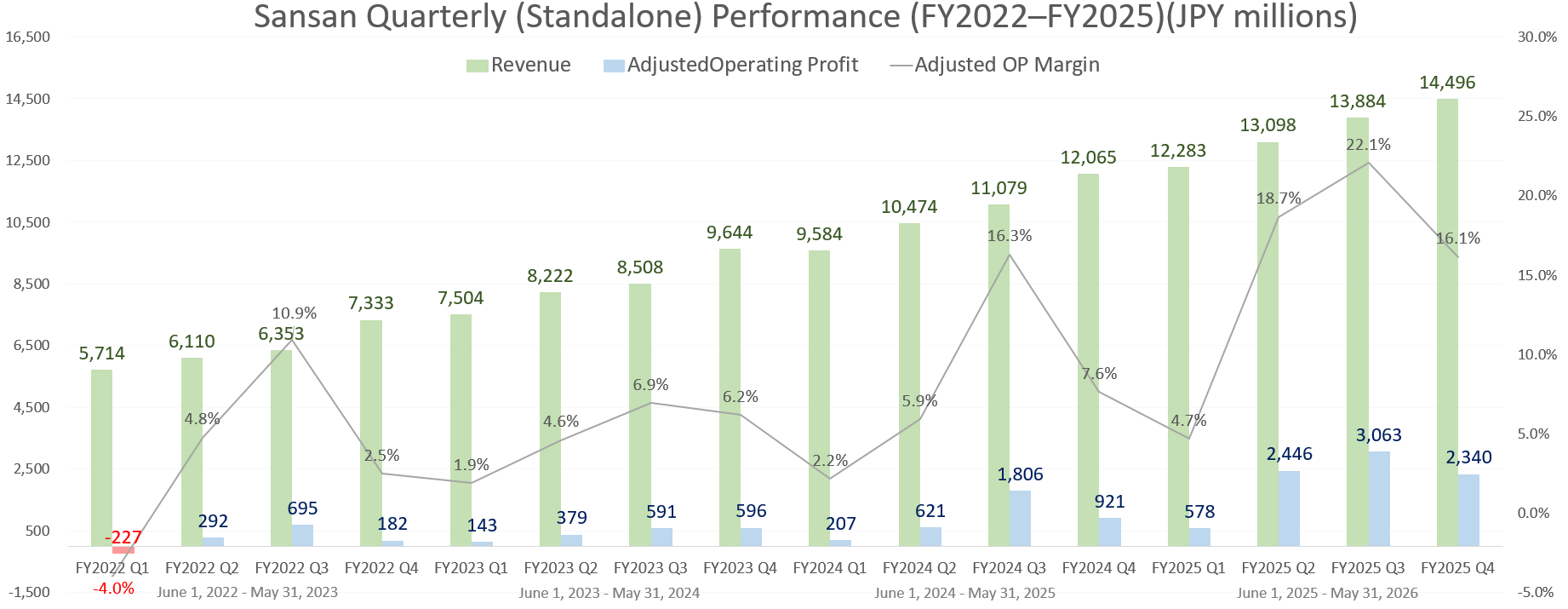
Quarterly results show steady top line growth alongside a still uneven but clearly improving margin trend.
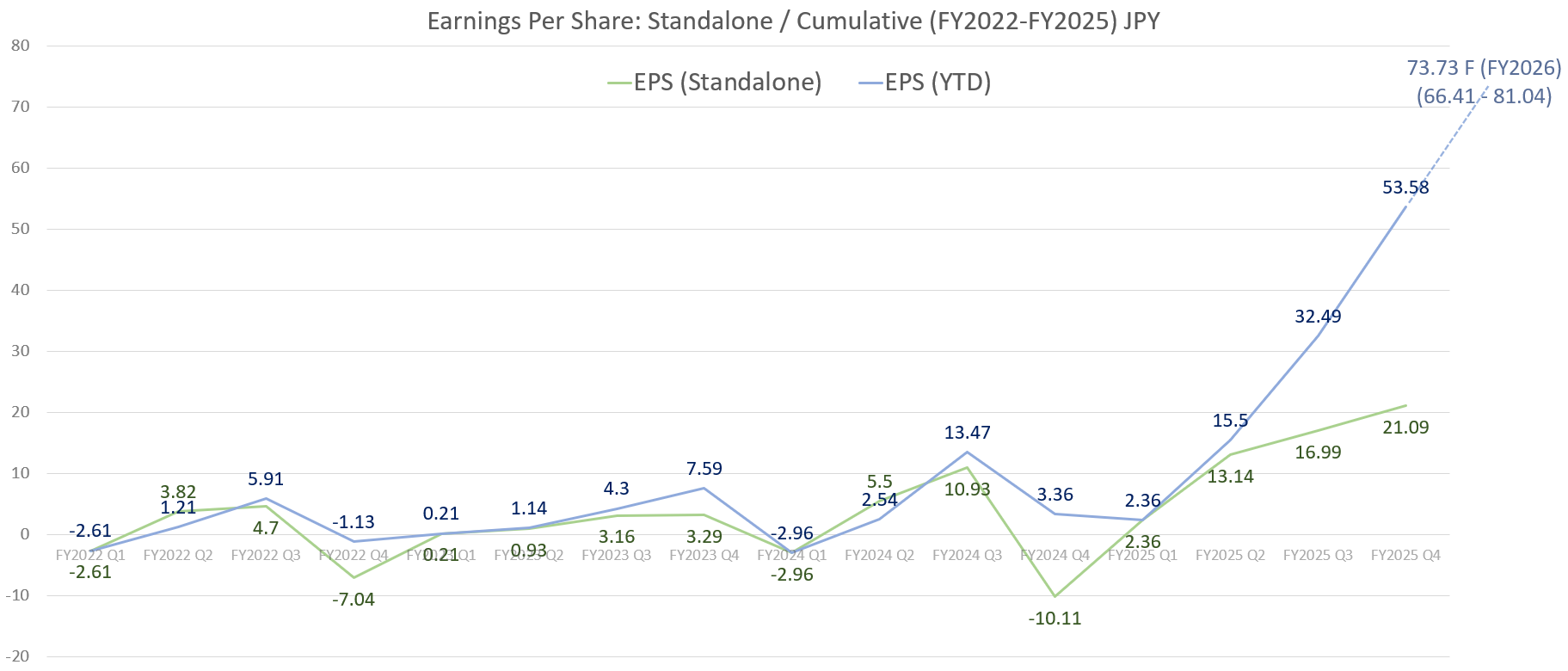
Standalone quarterly EPS remains volatile, but cumulative EPS has grown sharply, with FY2026 guidance implying continued momentum.
The charts above show that Sansan has more than doubled its revenue over the past four years while steadily improving profitability. Before looking at the business in detail, it helps to cover some basic background on the company.
Sansan Inc. was established on June 11, 2007. It listed on the Tokyo Stock Exchange Mothers market on June 19, 2019, moved to the First Section during fiscal 2021, and now trades on the Prime Market following the exchange's market restructuring in 2022. The company is headquartered at Shibuya Sakura Stage in Tokyo. Chikahiro Terada, the founder, serves as Representative Director and CEO. As of the end of May 2026, the company had 2,336 employees and capital of 7,358 million yen.
The company states its mission as turning encounters into innovation, and its vision as becoming business infrastructure. Starting from the simple act of exchanging business cards, Sansan has built its business around structuring corporate data, and this idea has remained consistent throughout the company's growth.
Business Results Overview
Sansan’s fiscal year runs from June 1 to May 31 of the following year. In this piece we follow the company’s own English naming convention, so FY2025 refers to the period from June 1, 2025 to May 31, 2026.
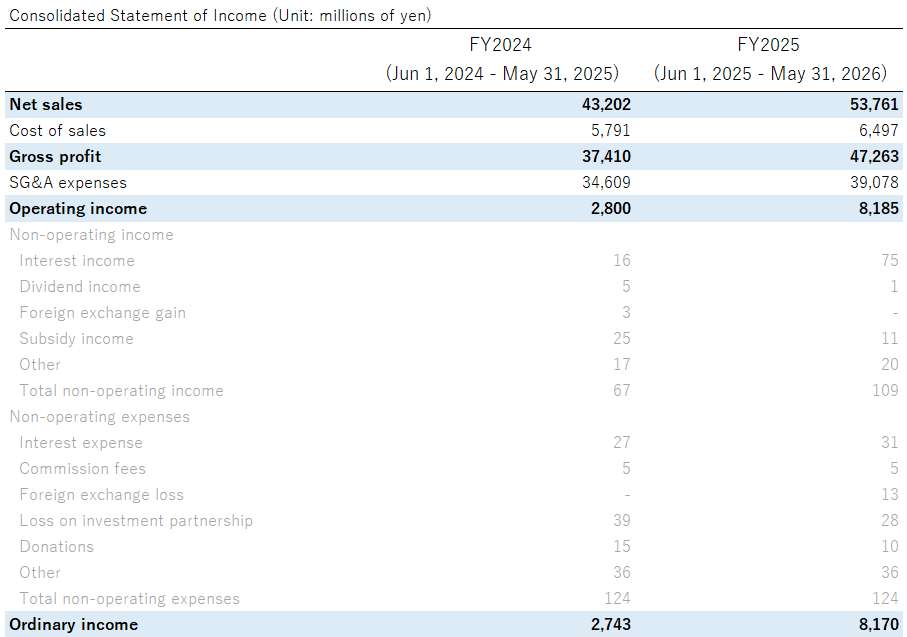
For FY2025, consolidated revenue came to 53,761 million yen, up 24.4 percent year over year. Adjusted operating profit reached 8,427 million yen, up 137.0 percent, also a record for the company. The adjusted operating profit margin rose to 15.7 percent, more than four times the 3.7 percent recorded in FY2022, which ran from June 2022 to May 2023.
The company reports its results under two segments. One is Sansan / Bill One, which covers its sales and accounting focused AX services. The other is Eight, built around its personal business card app. Contract One belongs to the Sansan / Bill One segment. Within that segment, though, it is not broken out on its own. It sits in an other category alongside Nine Out, a group company, which together made up about 4 percent of that segment’s revenue in FY2025.
For the purpose of explaining what the company actually does, the next section looks at the business through four separate solutions, Sansan, Bill One, Contract One, and Eight, rather than the two reporting segments used in the financial statements.
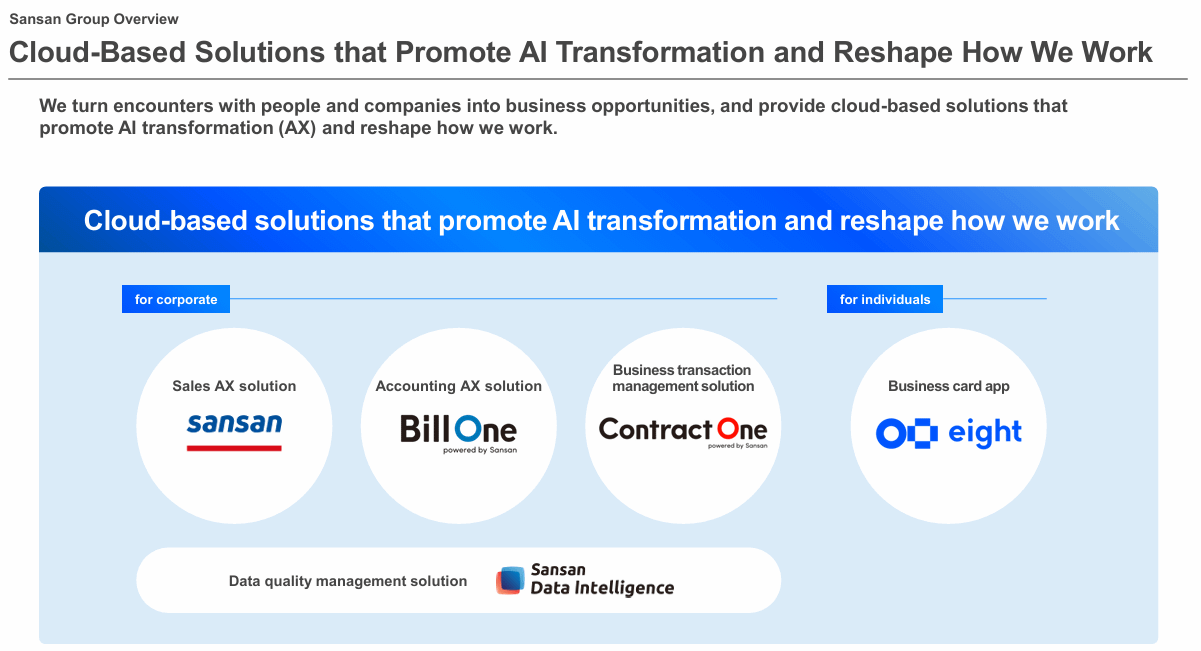
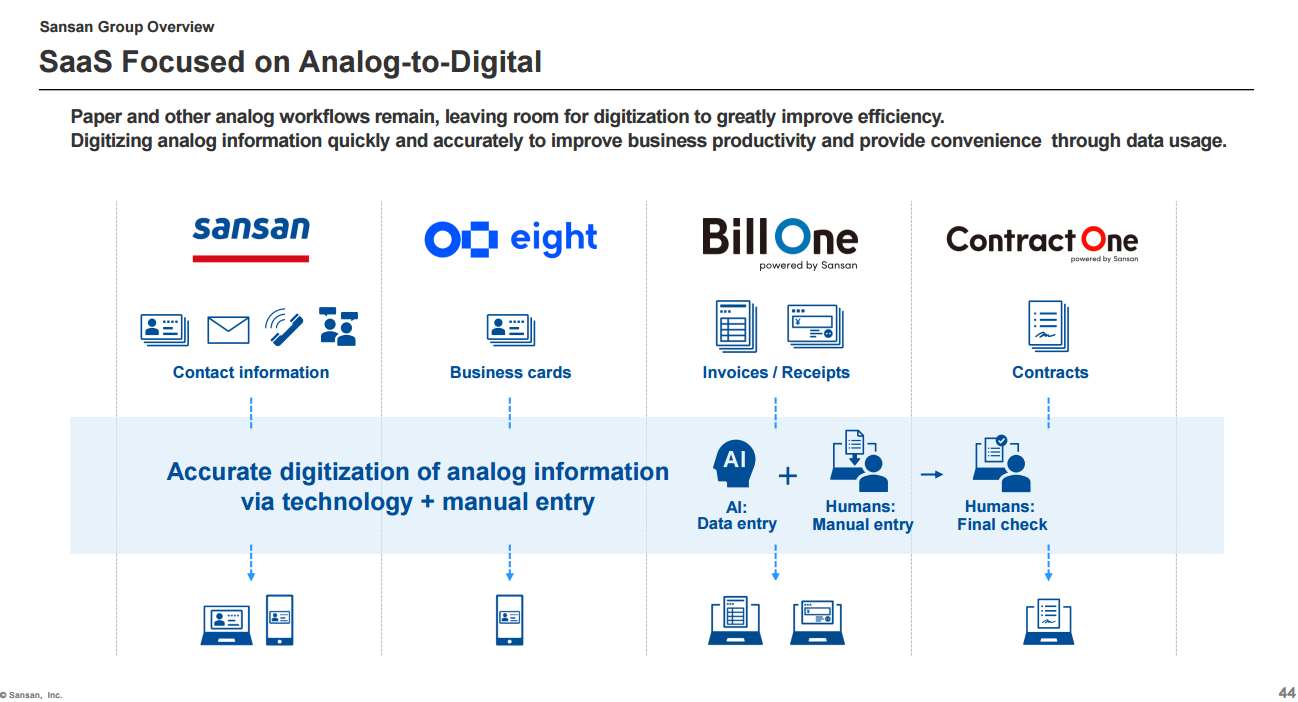
Source: SansanPresentation Materials for FY2025
Business Overview
Sansan (the service)
Before getting into details, one thing worth clearing up. The name Sansan refers to the company as a whole, and also to its main product. In this section, unless noted otherwise, Sansan refers to the product itself, the business card management and sales DX service.
What Sansan actually does
In plain terms, Sansan is a tool that takes the contacts employees naturally build up through their daily work and turns them into something the whole company can use.
At most companies, when a salesperson exchanges a business card, that card usually ends up sitting in a drawer or a phone, and the company as a whole has no easy way to know who met whom, at which company, and when. Sansan pulls this scattered information together into one place where it can be searched and put to use.
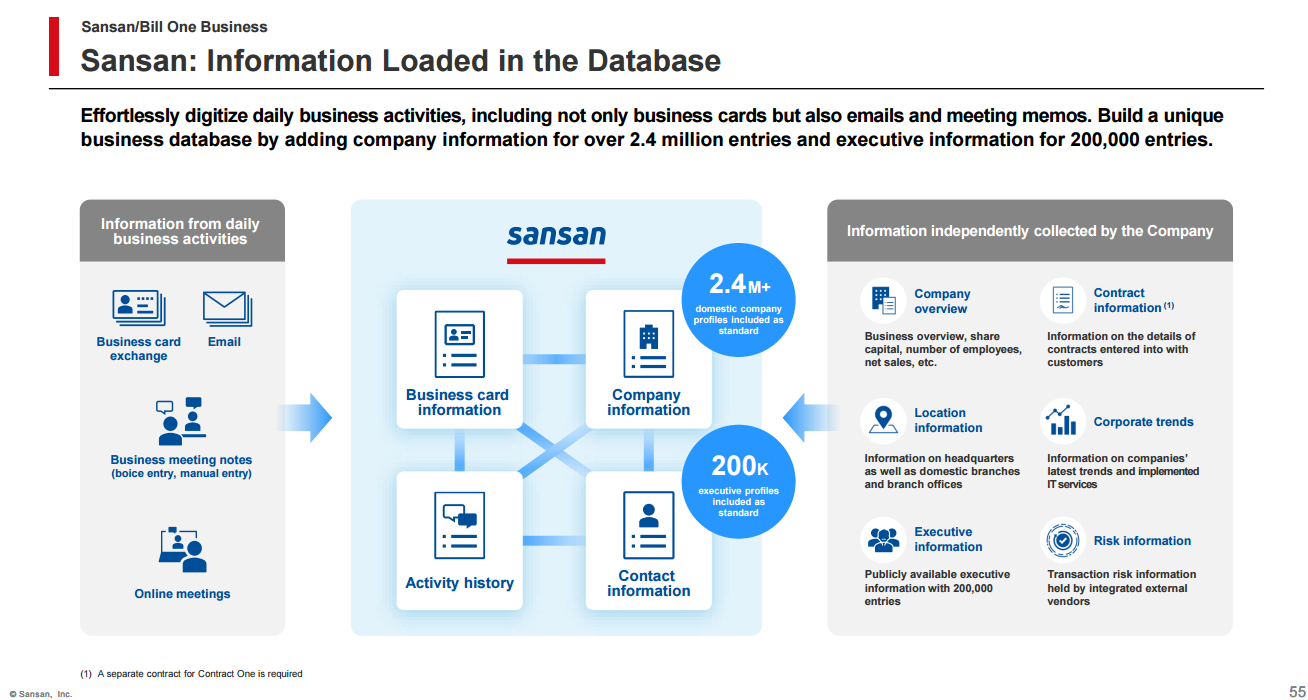
Source: SansanPresentation Materials for FY2025
What goes into the database
Two types of information feed into the Sansan database.
Information from everyday work
Business cards, digitized simply by scanning them, along with emails, meeting notes taken by voice or by hand, and contacts made through online meetings.Information the company gathers and adds on its own
Basic company data on more than 2.4 million firms, covering business overview, capital, employee count, and sales figures, along with executive information on 200,000 individuals, office locations, recent company developments, and risk related data from outside vendors.
Put together, this is not just a digital business card holder. It becomes a database that can show which person, at which company, in which role, had contact with whom on the sales side, and when.
Why this is useful
A salesperson can find out that another team already has a relationship with a decision maker at a target company, which saves time on cold outreach.
When an employee leaves or changes roles, the contacts they built up stay with the company rather than leaving with them.
Before a meeting, a salesperson can quickly check a company’s latest news and the roles of the people involved.
Contract metrics
As of the end of FY2025, Sansan had 12,199 contracts, up 14.0 percent year over year. Its trailing twelve month average monthly churn rate stood at 0.55 percent, staying below 1 percent.
A note on disclosure
Sansan does not report its own segment profit separately. What is disclosed is the combined adjusted operating profit for the Sansan / Bill One segment as a whole, shown in the chart below. Because of this, we first look at the trend for the segment as a whole, then turn to the recurring revenue figures that are broken out for Sansan specifically.
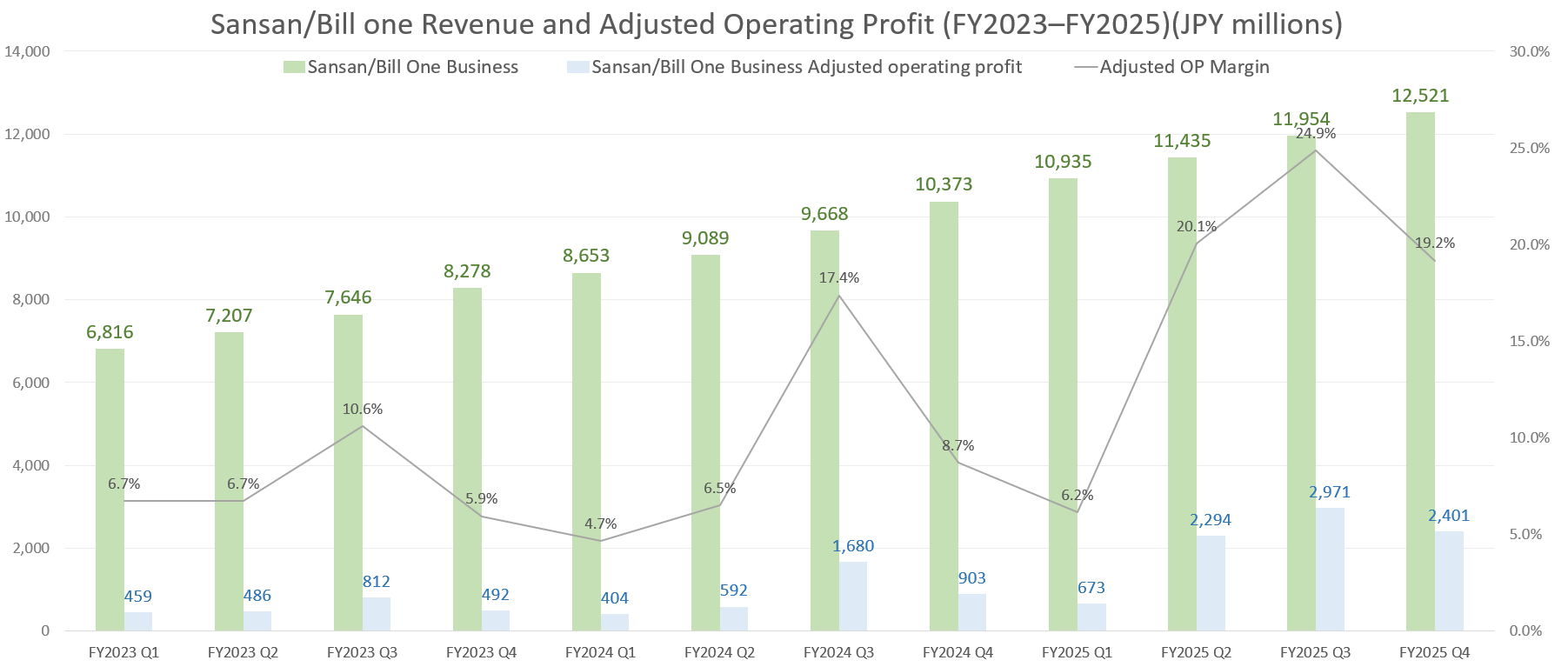
For the segment as a whole, the adjusted operating profit margin rose from 6.7 percent in FY2023 Q1 to 24.9 percent in FY2025 Q3. This improvement reflects both Sansan's own stable revenue base and the narrowing losses at Bill One, covered in the next section.
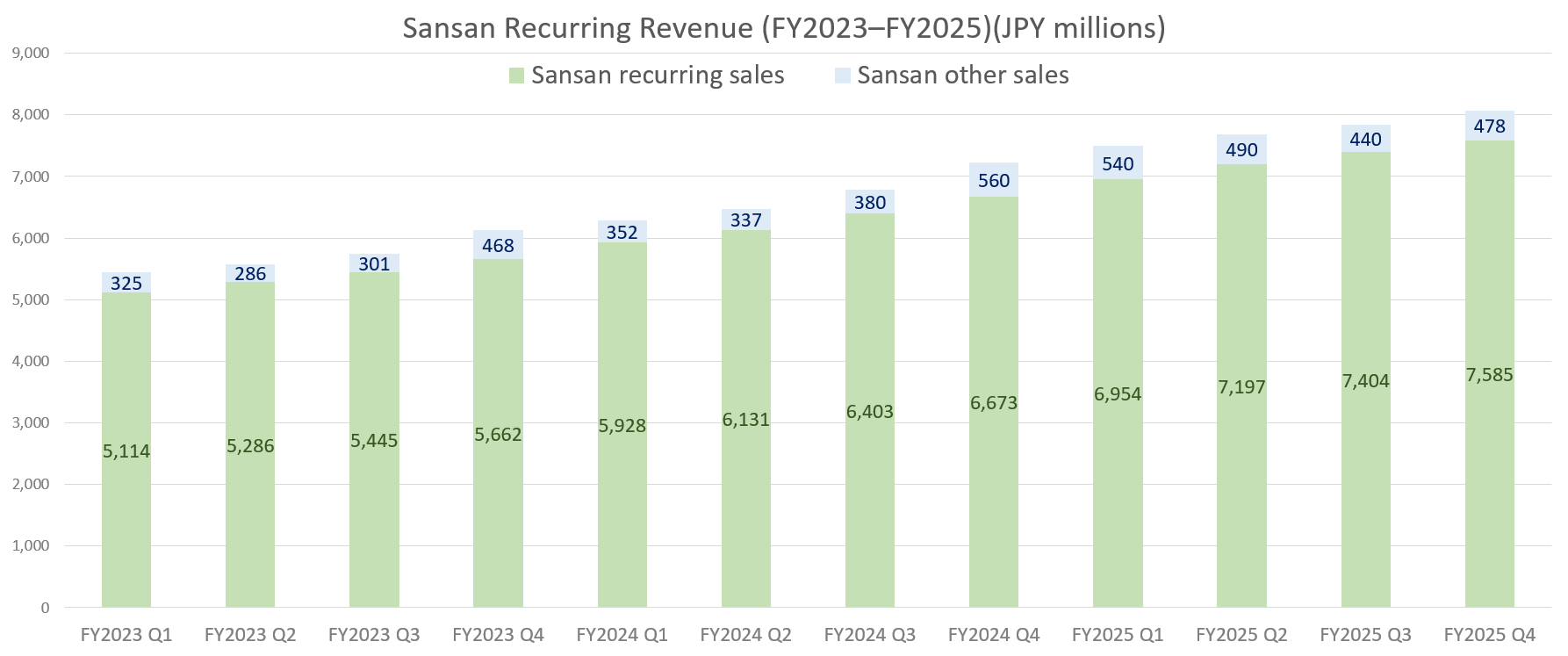
Looking at Sansan on its own, recurring revenue grew steadily from 5,114 million yen in FY2023 Q1 to 7,585 million yen in FY2025 Q4. This steady buildup is what underpins the strong profitability of the Sansan business as a whole.
Bill One
What Bill One actually does
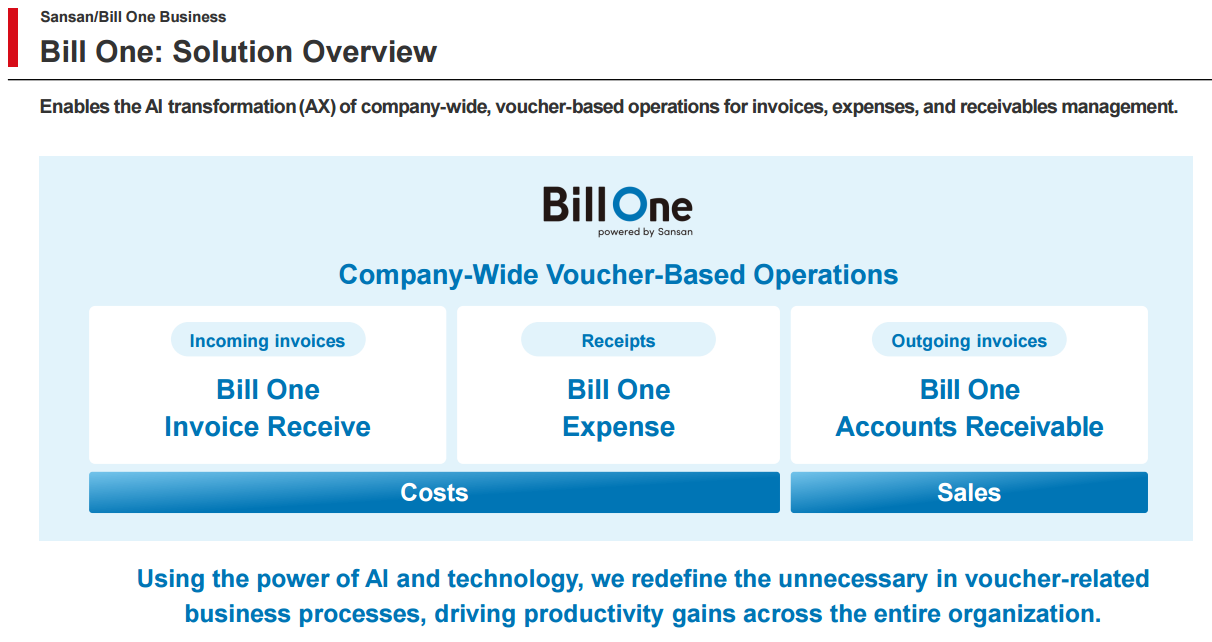
In plain terms, Bill One is a service that handles the paperwork behind accounting work, things like invoices, expense receipts, and payment records, and digitizes it accurately on the company’s behalf.
At most companies, invoices from suppliers arrive in different formats, some on paper, some as PDFs, some as email attachments. Someone in accounting has to check each one and enter it into the accounting system by hand.
This work is tedious, and it is often part of why closing the books each month takes so long. Bill One takes on this paperwork so the company does not have to.
Source: Sansan Presentation Materials for FY2025
The three areas Bill One covers
Bill One handles paperwork tied to accounting in three main areas.
Invoices received, through Bill One Invoice Receiving. It receives invoices from suppliers online, in whatever format they arrive, and digitizes them accurately.
Receipts, through Bill One Expense. Employees use a company card, so there is no need to pay out of pocket and file for reimbursement later.
Invoices issued, through Bill One Accounts Receivable. This covers creating and sending the company’s own invoices, all the way through to confirming payment.
The idea behind combining these three is to remove as much of the manual work around paperwork as possible, and in doing so, raise productivity across accounting as a whole.
Source: Sansan Presentation Materials for FY2025
How the core service, Bill One Invoice Receiving, works
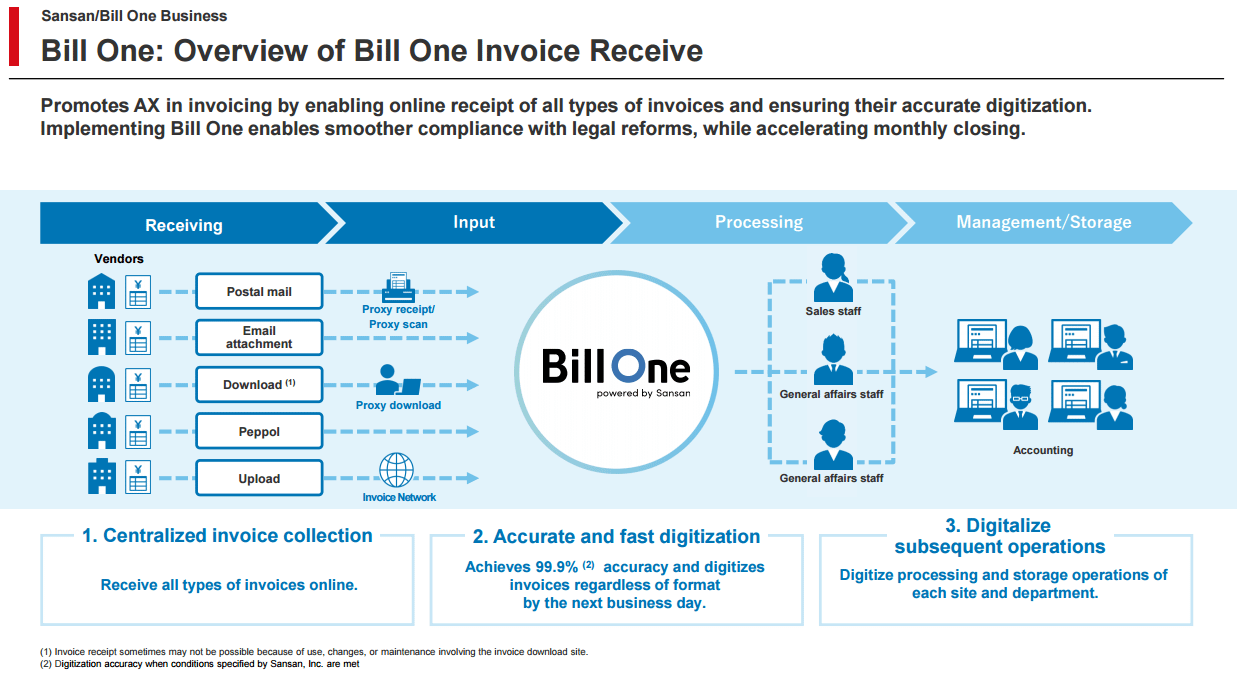
Of the three areas, Bill One Invoice Receiving is the core service. It works in four steps.
Receiving. Whatever way a supplier sends an invoice, by mail, email attachment, a download link, Peppol, which is a common standard for electronic invoices, or a direct upload, Bill One receives it on the company’s behalf.
Data entry. Bill One digitizes each invoice it receives. Under the conditions the company specifies, accuracy reaches 99.9 percent, and the data is ready by the next business day.
Processing. Once digitized, the information is automatically shared with the relevant people inside the company, such as staff in sales or general affairs.
Storage and management. Everything from there, including accounting and recordkeeping, can be handled digitally in one place.
Why this matters
There is no need to come into the office just to open and check paper invoices.
Manual entry errors and missed checks become less common.
It becomes easier to comply with recent legal changes, such as the electronic bookkeeping law and the invoice system.
Bill One’s growth to date
As of the end of FY2025, Bill One’s annual recurring revenue reached 14,782 million yen, up 34.9 percent year over year. Paid contracts stood at 5,188, up 31.9 percent. Its trailing twelve month average monthly churn rate was 0.34 percent, even lower than Sansan’s.
Profitability trend
Bill One has spent a long stretch in an investment heavy phase and has run at a loss on its own. That loss has been narrowing steadily. According to company disclosures, the adjusted operating profit margin for FY2025 improved to negative 11.9 percent, alongside a three year revenue CAGR of 78.3 percent.
The company expects Bill One to turn profitable for the full fiscal year in FY2026, which runs from June 2026 to May 2027 and corresponds to what is labeled the fiscal year ending May 2027 in Japanese disclosures.
Contract One
Source: Sansan Presentation Materials for FY2025
What Contract One actually does
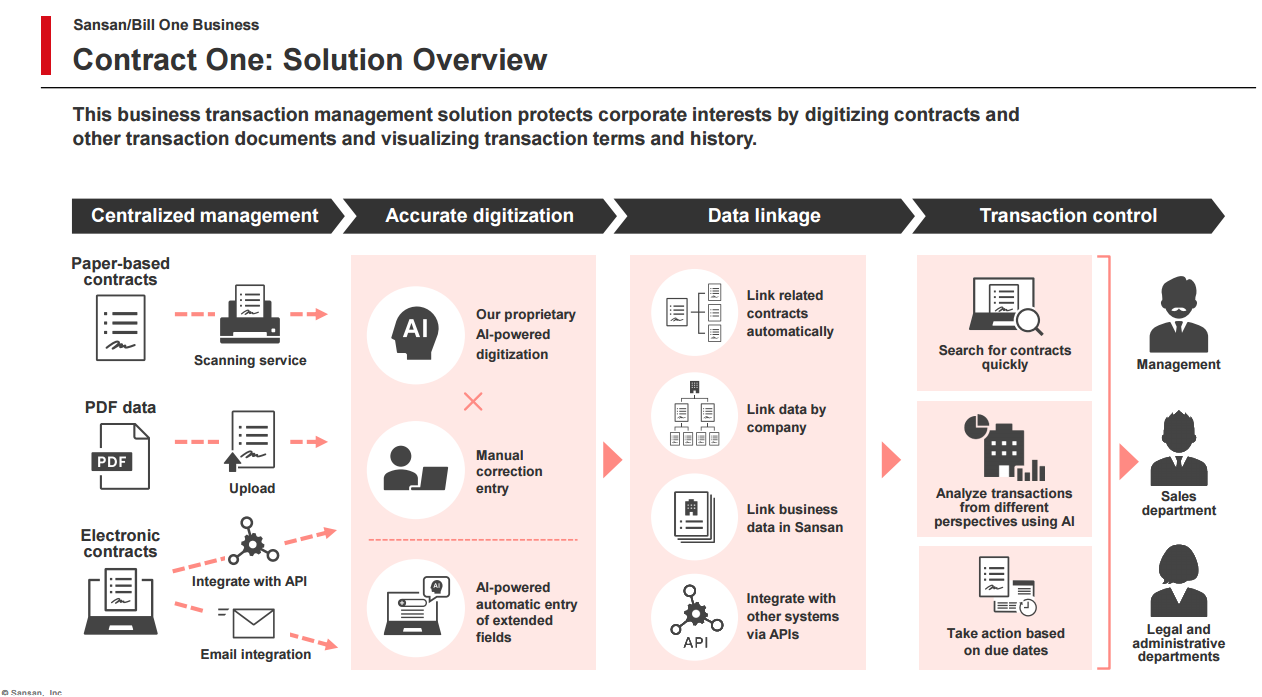
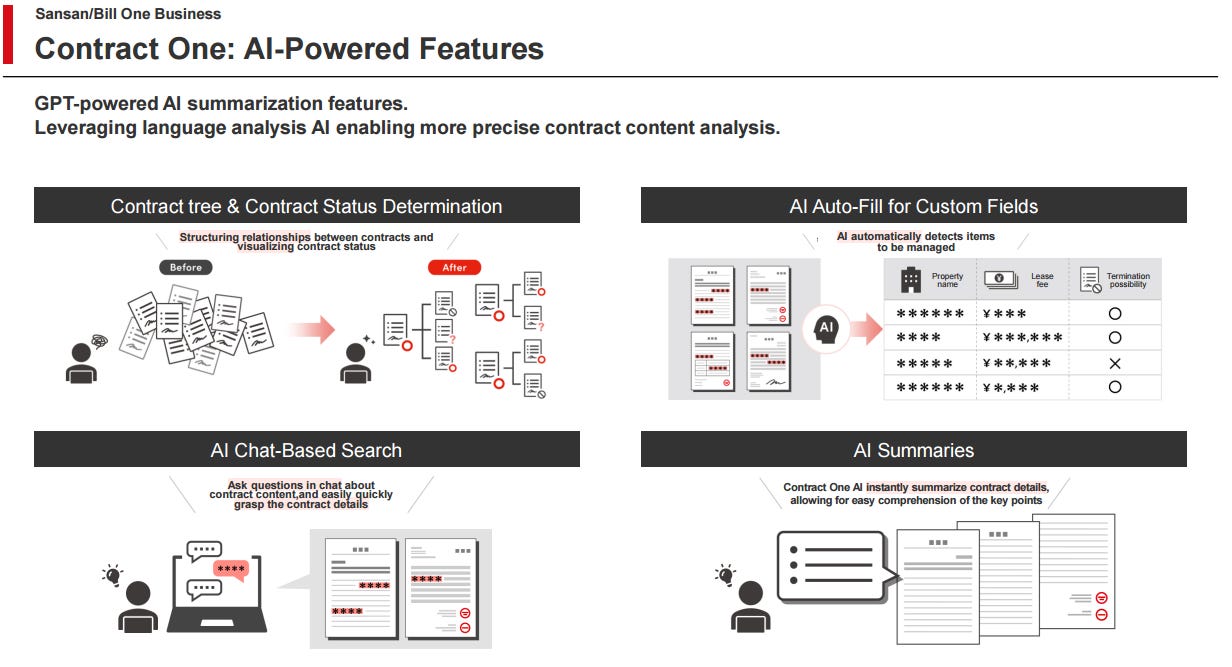
Contract One brings together contracts that are otherwise scattered across different departments and digitizes them accurately, so the whole company can see and manage what those contracts actually say. The service launched in January 2022.
At many companies, contracts are stored department by department. It often becomes unclear which contract is due to renew automatically, or what terms were agreed on in the past. Contract One addresses this by turning contracts into something the company can actually use as an asset.
How it works
Paper contracts, PDFs, and electronic contracts are all pulled into one place, then digitized accurately using in house AI along with manual corrections where needed. The service also links related contracts together, groups them by company, and connects with outside systems. This lets management, sales, and legal teams search contracts quickly and act on upcoming deadlines.
Key AI features include a contract tree that maps out how contracts relate to each other, automatic extraction of fields the user wants to track, a chat based search that answers questions about contract content, and a summary feature that condenses contract details.
Through something called an MCP server, external AI tools such as ChatGPT and Claude can also securely reference Contract One’s contract data and the company’s own review standards.
Growth and profitability
In FY2025, which ran from June 2025 to May 2026, Contract One generated 1,101 million yen in revenue. Its three year revenue CAGR of 73.2 percent is the highest among the four solutions.
The company expects revenue to grow 80 to 90 percent year over year in FY2026, running from June 2026 to May 2027. On the other hand, its adjusted operating profit margin stands at negative 184.9 percent, making it the most investment heavy of the four solutions.
The company plans to work toward profitability through solutions aimed at specific use cases, including one for legal work and another addressing new lease accounting standards, the latter due for release in July 2026.
Eight
Source: Sansan Presentation Materials for FY2025
What Eight actually does
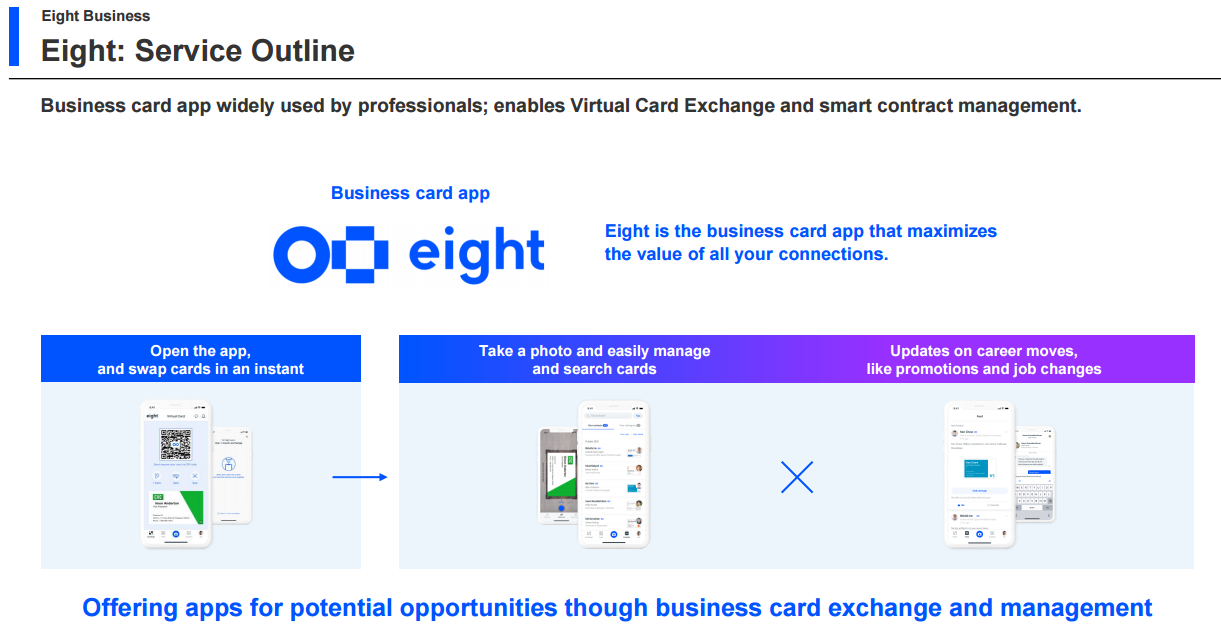
Eight is a personal business card app with digital exchange and management features. Sansan, Bill One, and Contract One are all services companies pay for and use as company assets. Eight works differently. It is a free app used by individuals, and it becomes that person’s own career and network asset.
If someone leaves their job or changes roles, the contacts and business cards they saved in Eight stay with them, on their own phone.
Main features
Open the app and exchange a digital business card right away
Manage and search cards simply by photographing them, which digitizes them automatically
Get notified when a contact changes jobs, gets promoted, or moves to a new role
How a free app for individuals generates revenue
Eight itself is free, but the company monetizes the large user network it has built through paid services aimed at businesses. There are three main types.
The first is card management, which includes extra features for individual users through Eight Premium, and a version for companies to share cards internally through Eight Team.
The second is business events, which draw on Eight’s network to run events for corporate clients.
The third is recruiting, through Eight Career Design, which lets companies reach out directly to people who are doing well in their current jobs but have not yet started looking for a new one.
Why the recruiting business matters
Of the three, the recruiting service connects most closely with the broader growth story covered later in this piece. Eight gives companies a way to reach talented people before they start actively job hunting.
In Japan, the job change rate among full time employees has reached a record high, and workers increasingly see managing their own careers as their own responsibility rather than the company’s. Eight’s positioning fits well with this shift.
In May 2026, the company acquired Eadoor, a recruiting firm, folding it into a subsidiary called Eight Career Inc to strengthen this part of the business.
Growth and profitability
In FY2025, running from June 2025 to May 2026, the Eight business generated 6,720 million yen in revenue, up 33.0 percent year over year. BtoB services made up the large majority of that, at 93.4 percent.
The adjusted operating profit margin came to 3.5 percent, with a three year revenue CAGR of 32.8 percent. That is lower than Sansan’s 38.9 percent, but Eight has been profitable every year since FY2024, which ran from June 2024 to May 2025. The company expects revenue growth of 23.0 to 27.0 percent in FY2026.
Growth Story
A compounding loop behind Sansan’s data digitization, one that is hard to copy
Sansan’s edge does not come from any single piece of technology. It comes from a loop that keeps reinforcing itself. More data leads to more accurate AI, which lowers the cost of manual work, which frees the company to expand into new areas, which then generates more data to feed back into the loop.
This loop started with data the company has built up over roughly nineteen years since it was founded in 2007. When entering business card data by hand, Sansan has two or more operators enter the same card separately, and only accepts the result once both match.
Tens of thousands of operators, both in Japan and abroad, work on this process, according to the company’s own investor disclosures. Reaching this scale of training data and operational setup is not something a new entrant can do quickly.
This kind of accumulation cannot simply be bought by hiring more people. As AI takes on a larger share of the work, the portion that still needs manual handling shrinks, and each worker can process more. As a result, cost of sales has grown more slowly than revenue, and the cost of sales ratio has in fact declined year after year.
What matters even more is that the underlying skill, turning unstructured data into structured data, has not stayed limited to business cards. The company has carried it over to invoices through Bill One and to contracts through Contract One, each a completely different kind of document. Every time a new type of data is added, it feeds back into the same loop and strengthens it further.
What makes this hard to replicate is that copying just one piece of it does not work. A strong AI model alone cannot function reliably without the large scale manual operation behind it. Manual labor alone, without a large body of data to learn from, cannot reach high accuracy either.
And expanding into new areas only becomes possible once both of these have matured, which is really the payoff after the loop has run many times over. This kind of advantage takes years to build, and that is what gives Sansan its long term edge.
Bill One's rapid growth, with profitability now within reach
The strength behind Sansan’s compounding data loop is already showing up in Bill One’s actual numbers.
As of the end of FY2025, Bill One’s annual recurring revenue reached 14,782 million yen, up 34.9 percent year over year. Paid contracts climbed to 5,188, up 31.9 percent, and the trailing twelve month average monthly churn rate stayed well under 1 percent at 0.34 percent. Bill One holds a 49.0 percent share of the domestic cloud invoice receiving market, ranking first for four straight years.
These figures suggest Bill One has moved past the stage where it was judged mainly on future promise. Its growth can now be checked against results every quarter.
The market backdrop behind this growth also looks more structural than temporary. According to research from Deloitte Tohmatsu Mic Research Institute, Japan’s cloud invoice receiving market is projected to reach 74 billion yen by fiscal 2029, growing at an annual rate of 29.3 percent.
Sansan has pointed to a few factors behind this, including compliance with the electronic bookkeeping law and the invoice system, faster adoption of electronic invoicing among trading partners following a 2024 rise in postal rates, and a persistent labor shortage in accounting and back office work.
Profitability has also moved forward. After a long stretch of heavy upfront investment, Bill One narrowed its adjusted operating loss to a margin of negative 11.9 percent in FY2025, and the company expects it to turn profitable for the full year in FY2026, running from June 2026 to May 2027.
If that plays out as planned, Bill One would shift from being simply a growth business to becoming one of the company’s core sources of profit, alongside the Sansan business itself.
Eight’s recruiting business rides a shift in the labor market
Sansan and Bill One both focus on corporate back office work. Eight builds on a different asset entirely, the career histories and networks of individuals. Within Eight, the recruiting service, Eight Career Design, is the part most directly tied to a broader shift underway in Japan’s labor market.
Job changes among full time employees in Japan have reached a record high. According to a Mynavi survey, the job change rate for full time workers hit 7.6 percent in 2025, the highest since the survey began. At the same time, attitudes among job seekers appear to be shifting.
Research on why younger workers leave their jobs suggests that better pay and conditions alone are no longer enough to retain them, pointing instead to a growing sense that people want to take ownership of their own careers, seeking meaning and room to grow in their work.
Job seekers increasingly value feeling sure about a move over simply timing it well, and many who do change jobs cite a sense of stagnation in their previous role.
This points to a shift in the balance between employers and workers. Companies used to be the ones doing the choosing. Now, skilled workers are increasingly the ones choosing where to work. Eight’s direct recruiting business is built around this shift.
It lets companies reach out to people who are performing well in their current jobs but have not yet started looking elsewhere, a different approach from traditional recruiting, which waits for candidates to apply on their own.
The company has been investing in this area. In May 2026, it acquired Eadoor, a recruiting firm, folding it into a subsidiary called Eight Career Inc to build out this business.
Eight as a whole generated 6,720 million yen in revenue in FY2025, up 33.0 percent year over year, with BtoB services accounting for 93.4 percent of that total. Recruiting is one of the pillars supporting this growth.
Valuation
A simple PER is not a good fit for looking at Sansan’s valuation.
Non cash accounting items, such as stock based compensation and goodwill amortization, have caused GAAP earnings to swing widely over a long stretch. On top of that, the company runs several businesses that sit at different investment stages at the same time.
Quarterly EPS has moved between profit and loss more than once. At one point, trailing PER briefly reached levels in the hundreds. At that point, PER stops being a useful measure of value.
For this reason, this piece uses EV /EBITDA instead. This multiple takes enterprise value and divides it by operating profit plus depreciation and goodwill amortization. It strips out non cash costs and gets closer to the cash the business actually generates.
One note on method. Stock based compensation is treated here as a real cost, since it represents actual compensation to employees, so it is left in rather than added back.
Looking at how this multiple has moved, it fell from 125.5 times at the end of FY2022 to 75.7 times at the end of FY2023, then to 58.0 times at the end of FY2024, and to 19.2 times at the end of FY2025.

This drop did not come from a falling enterprise value. It came from EBITDA growing much faster over the same period. As of September 2026, the multiple stands at 25.1 times on a trailing basis, using FY2025 actual results. On a forward basis, using the company’s FY2026 guidance, it comes to 16.0 times.
Comparing this with other domestic SaaS companies puts the number in context.
Among major listed peers, Rakus trades at a forward EV/ EBITDA of 16.78 times, close to Sansan’s 16.0 times. freee and Money Forward trade higher, at roughly 35.4 times and 59.54 times respectively.
The gap between Rakus and the other two likely reflects where each company sits in its path to profitability. Sansan’s multiple has moved closer to Rakus, a company further along that path, rather than to freee or Money Forward.
Taken together, these numbers do not point to a clear case that the stock is cheap. What they do show is that the sharp re-rating seen over the past few years, the shift away from a valuation built mainly on future promise, appears to be largely behind us at this point.
Balance Sheet
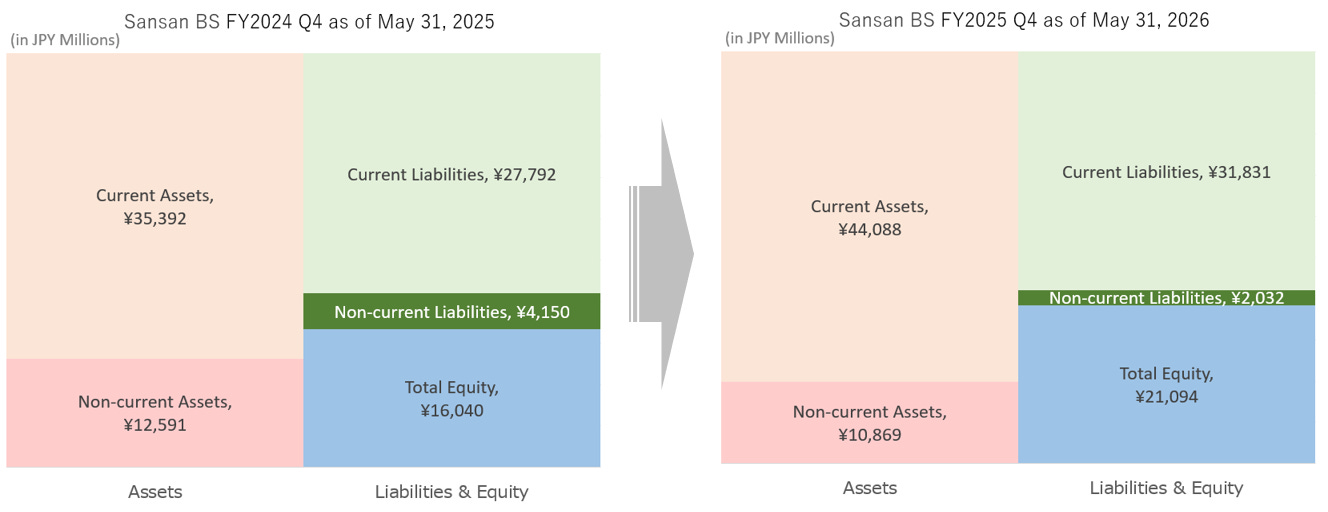
Sansan’s balance sheet has clearly strengthened over the past year.
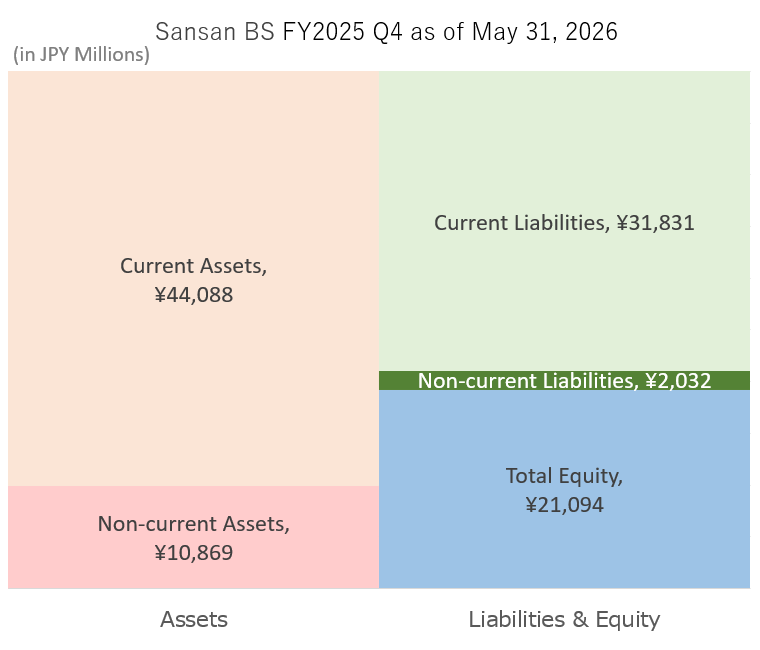
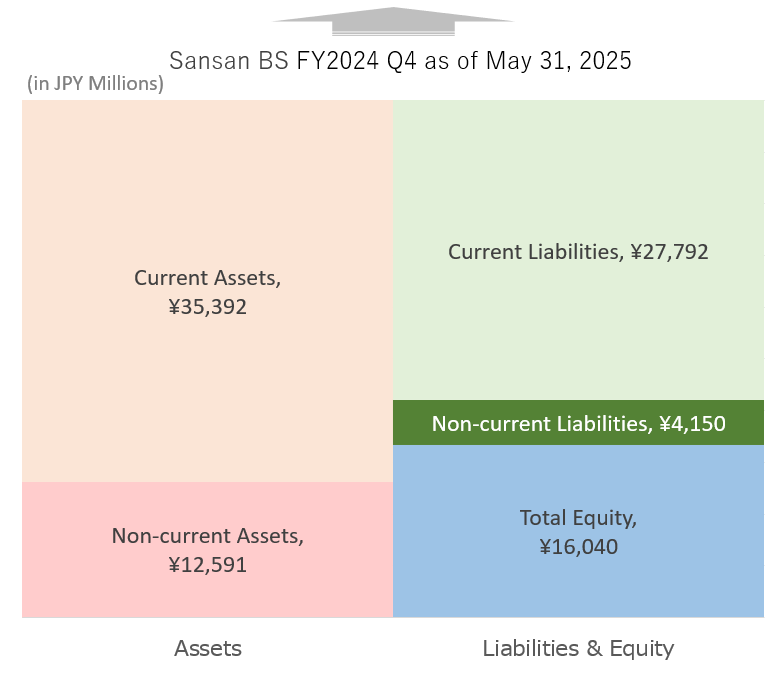
Between the end of FY2024, meaning May 31, 2025, and the end of FY2025, meaning May 31, 2026, total assets grew from 47,983 million yen to 54,957 million yen. Most of this came from an increase in current assets, which rose from 35,392 million yen to 44,088 million yen.
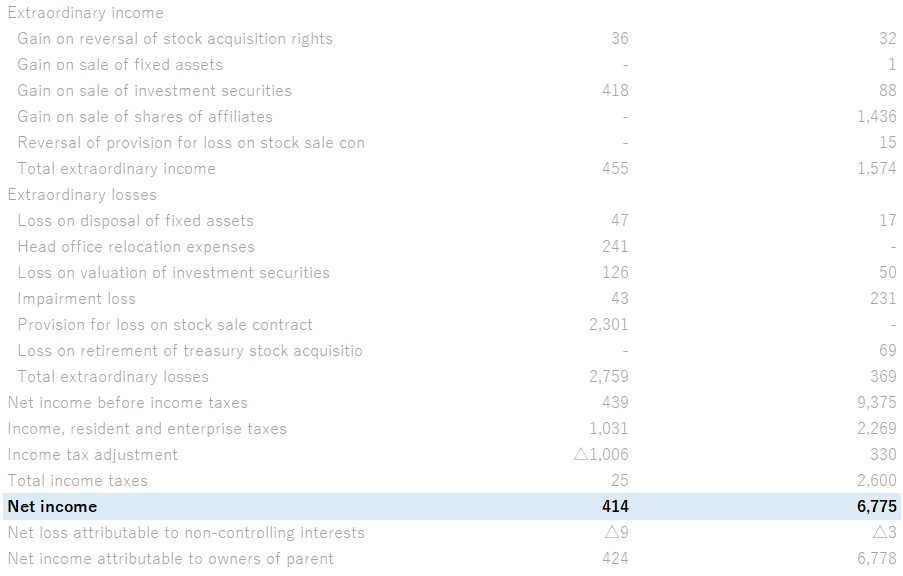
The equity ratio improved from 33.4 percent to 38.4 percent, and net assets grew from 16,040 million yen to 21,094 million yen. This increase mainly reflects net income of 6,778 million yen recorded in FY2025.
Fixed liabilities were cut roughly in half, falling from 4,150 million yen to 2,032 million yen. This was driven mainly by a decrease in long term borrowings of 1,759 million yen. Separately, within current liabilities, a provision for loss on sale of shares of 2,301 million yen was cleared during the year.
This provision was tied to a contract to sell shares in an affiliated company. The sale went through in FY2025, and it ended up generating a gain of 1,436 million yen, more than offsetting the provision that had been set aside.
Sansan’s equity ratio of 38.4 percent might look unremarkable on its own. Most of its liabilities, however, are non interest bearing items such as advance payments received from customers, and interest bearing debt totals just 1,908 million yen.
Cash and deposits stood at 37,006 million yen, putting net debt at negative 35,098 million yen, effectively a net cash position. This level of cash gives the company some cushion if business conditions were to turn worse.
Catalyst
Bill One’s path to profitability, confirmed step by step
The company expects Bill One to turn profitable for the full fiscal year in FY2026, which runs from June 2026 to May 2027.
There is one important limit to keep in mind when checking on this. Bill One’s own profit figures are not disclosed as part of the official segment data in the earnings report.
The negative 11.9 percent adjusted operating profit margin the company cites comes from a supplementary figure in its presentation materials, not from the formal segment disclosure, so outside investors cannot independently verify it using primary filings alone.
Because of this, tracking progress toward profitability means relying on a few indirect signals together.
The first is the trend in adjusted operating profit margin for the combined Sansan slash Bill One segment. This figure is disclosed in the official earnings report, and it rose from 6.7 percent in FY2023 Q1 to 24.9 percent in FY2025 Q3. Since the Sansan business on its own already runs at a high margin, at least part of this improvement likely reflects Bill One’s narrowing losses.
The second is the set of growth metrics the company does disclose, such as annual recurring revenue, paid contracts, and churn rate.
The third is what management itself has said in earnings briefings. At the July 2026 briefing, the company said Bill One’s loss had narrowed to around 1.6 billion yen, and that there were individual months where it turned profitable.
Reaching the profitability the company has guided to will need to be assessed through this combination of indirect evidence, rather than through a single disclosed profit figure.
Pricing impact from AI search
Source: Sansan Presentation Materials for FY2025
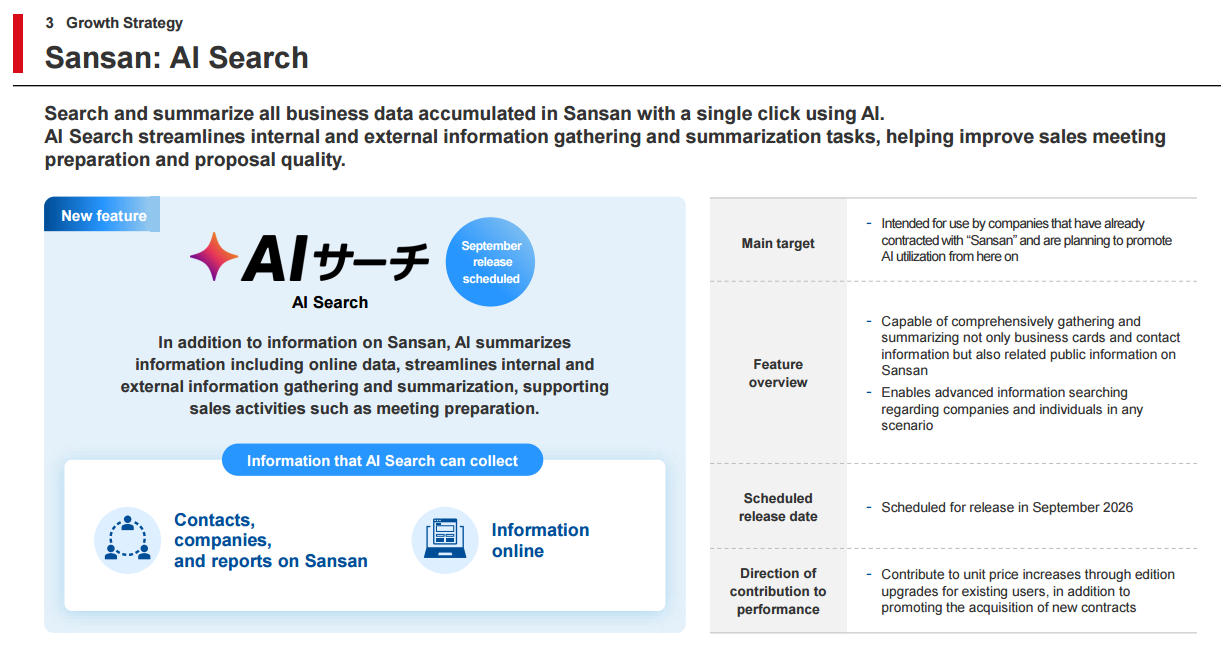
AI Search, launched for the Sansan product in September 2026, has not yet been tested by results.
What makes this feature worth watching is that it is not just another add on. As the growth story section covered, Sansan’s strength rests on data the company has built up over nineteen years.
AI Search appears to be an early attempt to turn that accumulated database into something customers can directly experience, through AI based search and summarization, and in that sense to convert the compounding loop discussed earlier into actual revenue.
It is also worth noting that AI Search is not sold as a separate add on. It comes standard with the Standard edition and above.
This means existing customers who want to use it need to move up to a higher tier plan. Whether this pricing approach works may also offer a read on whether similar AI based pricing could work for Bill One and Contract One down the line.
Whether this feature is actually pushing customers toward higher tier plans should show up in Sansan’s monthly recurring revenue per contract. That figure had been drifting down, falling 1.0 percent year over year in the most recent period. Whether it turns back up in coming quarters is a concrete point to watch.
M&A as an ongoing option
Since 2023, the company has made small acquisitions at a pace of at least one per year, mostly in AI technology and in the recruiting side of the Eight business.
When the next deal will be announced is not something we can predict, and looking at past announcements alongside the stock’s price moves did not show a clear pattern, since other factors were often at play around the same time.
That said, a small deal that directly reinforces an existing strength would likely be easy to explain in terms of synergy, and could be well received.
Risks
Contract One’s continued losses
Contract One is the most investment heavy of the four solutions. Its adjusted operating profit margin stands at negative 184.9 percent, a deeper loss than Bill One’s negative 11.9 percent. While the company has stated it expects Bill One to turn profitable for the full fiscal year in FY2026, running from June 2026 to May 2027, it has not given a similar timeline for Contract One.
The company is rolling out solutions for specific use cases, including one for legal work and another for new lease accounting standards, but when or how much these will contribute to profitability is not yet clear.
Concentration among founders and related shareholders
Ownership at Sansan is fairly concentrated among the founding team. The largest shareholder, CNK, is the asset management company of founder and CEO Chikahiro Terada. Combined with his personal holdings, this comes to 32.33 percent of shares outstanding.
Adding in co founders Kei Tomioka and Kenji Shiomi, both currently serving as directors, brings the founding group’s combined stake above 37 percent. Shares held by a small number of major holders make up 64.70 percent of the total, leaving a limited amount actually trading in the market.
This kind of concentration cuts both ways. It aligns the founder’s interests closely with those of shareholders and can make it easier to move quickly on ambitious plans, such as the company’s medium term targets.
At the same time, it carries the usual concern that minority shareholders may have less influence over how the company is run. In 2024, a share purchase by the founder’s asset management company was disclosed as an action treated similarly to a tender offer under Japan’s financial instruments law, a sign that moves by major shareholders can be large enough to matter to the market.
Limited trading liquidity
The concentration described above also shows up in trading volume. Monthly trading volume in September 2026 came to roughly 15 million shares, which works out to about 0.6 percent of shares outstanding, excluding treasury shares, on a daily basis.
Stocks with lower liquidity are generally harder for institutional investors to trade in large size, and in theory this can translate into a valuation discount. That said, we have not found data showing how much, if at all, this affects Sansan’s current valuation.
Conclusion
What comes through in this analysis is that Sansan appears to be moving from a stock priced mainly on a growth narrative to one that can be judged on actual results.
This is not based on a single piece of evidence, but on several threads coming together. There is the compounding loop built on nineteen years of accumulated data and a hybrid of AI and manual work, something that is hard for others to copy.
There is Bill One, whose rapid growth and steady progress toward profitability back up that structure in practice. And there is Eight’s recruiting business, which is positioned to benefit from a shift underway in Japan’s labor market. None of these rest on future promise alone anymore. Each can now be checked against results every quarter.
This shift shows up clearly in valuation as well. Trailing PER had briefly reached levels in the hundreds, effectively useless as a valuation tool. Looking at EV to EBITDA instead, the multiple fell from 125.5 times at the end of FY2022 to 19.2 times at the end of FY2025.
As of September 2026, it stands at 25.1 times on a trailing basis, and 16.0 times on a forward basis using company guidance. This decline did not come from a falling share price. It came from profit growing much faster. Sansan’s multiple has moved close to that of Rakus, a domestic peer further along in profitability, and stands apart from freee and Money Forward, which remain in a heavier investment phase.
That said, this piece does not conclude that the stock is cheap. Much of the re-rating over the past few years already appears to be behind us. A few things still call for caution, including how much of the analysis relies on company guidance, the concentration of shares among founders, and limited trading liquidity. Contract One’s continued losses are also worth watching until a clearer path to profitability emerges.
So the conclusion here is straightforward. We do not see clear evidence that Sansan’s stock has further room to become cheaper. What we do think is that the growth story behind it is worth following closely.
How Bill One’s profitability plays out, what pricing impact AI Search ends up having, and where future acquisitions are aimed are all worth tracking through actual quarterly results. That is likely the most reliable way to keep tabs on this company going forward.
Balance Sheet (FY2024 Q4 ⇀ FY2025 Q4)
Profit and Loss Statement (FY2024 Q4 ⇀ FY2025 Q4)
Statement of Cash Flows (Summary) (FY2024 Q4 ⇀ FY2025 Q4)
